I’m moving over to Logseq from Roam Research but one trouble that I’m having is that it seems that it’s impossible to have compound page names in Logseq such as [[[[Logseq]] [[community]]]]. If I do this in Logseq and then click on the page name it brings me to a page called “Logseq]] [[community” and there will be no linked references. There are a lot of cases where I need two (or more) page links in the title of a new page which represents the union of those two items. For example, to keep track of my consulting projects I use a format for each project page somewhat like, "[[[[consulting]] [[client name]] project name]]. This way I can find these blocks by simply filtering for “consulting” or the “client name” alone or I can find links to the full compound page title which I use at the heading of each day’s work. I use this format all the time in Roam. I have tried successfully to use nested page names in Logseq such as [[[[Logseq]] notes]] or [[my 2023 trip to [[Asia]]]], but no luck with compound page names. Does anyone know if it’s possible to create compound page names like this in Logseq? Thank you!
In Logseq there are namespaces like [[Consulting/Alice/Project foo]] but this implies that [[Consulting/Alice]] and [[Alice]] would be different pages (at least if you don’t make them one the alias of the other).
You can filter progressively using [[Consulting]], [[Consulting/Alice]] and [[Consulting/Alice/Project foo]].
Thank youi! That’s helpful! So it’s not possible in Logseq to do a page name that has multiple page names in the title? like [[[[page A]] [[page B]]]]?
You can edit a page title to be like that but referencing that page wouldn’t work, so yeah Logseq doesn’t support that.
Looks like it’s been some time since this was discussed. The capacity to create and represent compound notes would be really helpful to me. Is there any possibility of making this into a feature request?
I’m putting my ideas here because I’m too impatient to earn the ability to make a topic, my apologies.
More specifically, I’m having trouble with how I’d like to relate ideas in this program. I want to create what are called compound nodes/notes/pages. Similar to the linguistic idea of compound words, the thinking is, if the most common type of node is a noun, then what happens when I want to make a new node that uses the meanings, symbolism, or context of two or more other nodes? Well, for right now, the program gets confused. It does kind of work, but not for more complicated structures like,
[[ [[SomeDude]]'s [[ [[Youtube]] [[Channel]] ]] ]]
where we’re making a new compound node out of a stem node and a compound node.
Additionally, when the program creates the compound node file, it doesn’t do a very good job of representing the compound node as being made up of a structure of stem nodes. However, it does a decent job with compound nodes of only two stem nodes like,
[[ [[Youtube]] [[Channel]] ]]
creating a node that allows you to jump to any individual stem nodes from its title, but fails at doing so with more complicated structures.
Further on the subject of representing compound nodes, I’d love to see the structure of the compound node reflected in the graph view. Possibly by making stem nodes internal to larger compound nodes in a venn diagram where compound nodes that use common stem nodes are represented as literally sharing a common concept by overlapping each venn of the compound nodes with the shared stem node or nodes.
Basically the graph view has to represent in some way that,
[[ [[Youtube]] [[Channel]] ]] and [[ [[River]] [[Channel]] ]],
share the same stem node [[Channel]].
Here’s a crude mockup of how I imagine the compound node/note/page, [[ [[NAME]]’s [[ [[Youtube]] [[Channel]] ]] ]] and [[ [[River]] [[Channel]] ]], would look in a graph view:
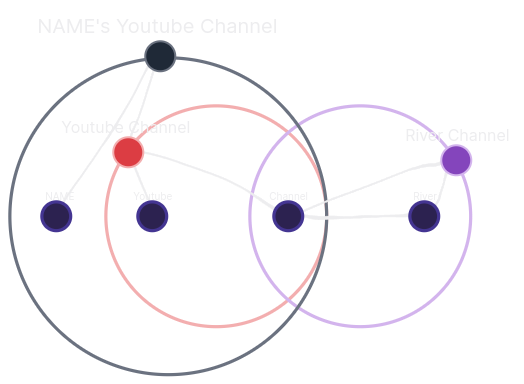
I recognize that a consequence of this would make the graph more crowded, as larger and larger compound nodes take up more room visually. Perhaps there should be an option to collapse larger compound nodes so that they hide their content, making the graph view visually cleaner, or to just toggle them off entirely, returning the graph view back to only showing non-compound relationships. Something like a “represent all nodes as stem nodes” toggle would help.
To conclude, I think following the tendency of language, to combine simpler topics into more complex ones, will create an experience that does not impose too many restrictions on the user and allows them to map out their own mental language, even if it requires a more complex program to facilitate it.
Gonna do a cheeky edit here to get that badge
Just thought I would mention that what you are trying to do (as far as I can tell) is possible in the DB version where everything is a node. I do something similar in my notes, although instead of using standalone pages I just dump everything in the journal. The principle is the same, and there is also the benefit of having the icons/sigils of tags in the links, which provides a nice visual cue in the titles of “compound notes” like you describe. Anyway, just food for thought!
That’s pretty cool! I guess I’ll have to try the DB version. I’ve just been playing around with logseq because it was available as a flatpak, but if what you’re saying is true, then I’d love to get my hands dirty and try the DB version.
It seems like a simple relationship between pages… What matters is the connection, not the connected objects.
Apart from that, if you put some text next to the outermost square brackets a new page with references is created. E.g.: [[txt [[page A]] [[page B]] txt]]
I have discovered a slight problem with this manner of node naming. In my case, those nodes that are compounded links to other nodes causes a severe lag when they are rendered by the “node picker” when assigning a property to another node.
For example, say I have a node like the one mentioned above (`[[ [[Youtube]] [[Channel]] ]] and [[ [[River]] [[Channel]] ]]`) that is tagged as #video (just for example). If I make a property whose values are set to be nodes with the tag #video, then when I go to set such a property in some other node there is a significant amount of lag (to the point that the UI freezes).